Make your garden office usable in a heatwave and through the winter, with one small split system.
Free, no obligationStandard or pre-charged systems
Quick answer
A garden room is one of the best places for air conditioning: it is a single, well-defined room that overheats in summer and gets cold in winter. A small split system, often around 2.5 kW, cools and heats it. A pre-charged system often suits, provided the outdoor unit sits close by and an electrician confirms the supply.
Updated October 2026
Uses
Why garden rooms need air conditioning
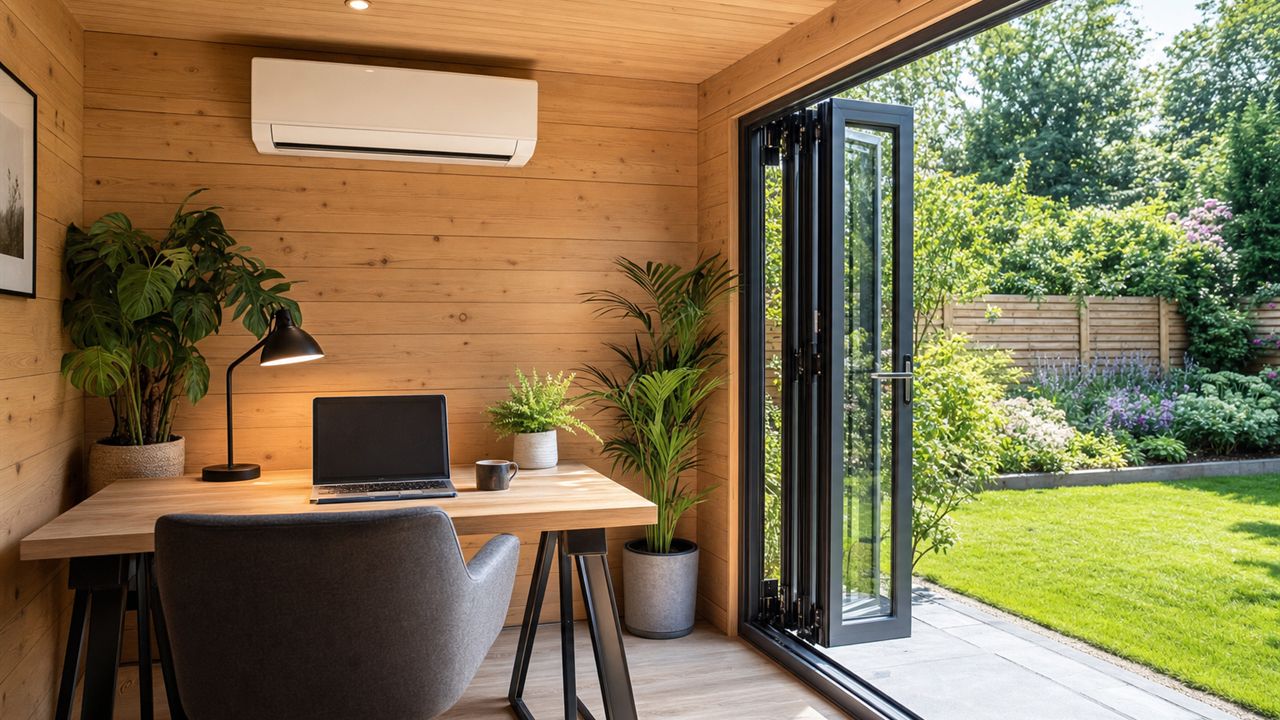
Home offices
Small rooms with screens and big windows overheat quickly in summer.
Year-round use
The same unit heats in winter, so the room is comfortable in every season.
Studios and gyms
Steady temperature for equipment, instruments and exercise.
Annexes and summer houses
Guest rooms and garden annexes, cooled and heated.
What to plan
Power. Most garden rooms are fed by an armoured cable from the house. Check there is capacity for the air conditioner on its own circuit.
Outdoor unit position. Usually on the side or back wall of the garden room, or on a ground stand beside it.
Pipe run. Keep it short. Pre-charged systems need the outdoor unit close by.
Insulation and glazing. A well-insulated room needs a smaller unit and costs less to run.
Condensate. Plan where the drain water goes, such as a soakaway or gravel.
Sizes for garden rooms
Garden rooms with lots of glazing need more cooling for their size than a house room.
Limited to the supplied kit unless a technician extends it
Indoor unit styles
Wall, floor, cassette, ducted
Mostly wall-mounted
Cooling and heating
Yes
Yes
Best for
Whole homes, larger rooms, businesses
One room where the outdoor unit can sit close by
How it works
Three steps to your quotes
Tell us about your rooms
Home or business, how many rooms and the system type you would like.
We match local installers
Only installers who cover your postcode and fit your system type.
Compare your quotes
Weigh up prices, equipment and warranties, then choose, if you want to.
Jargon buster
Air conditioning terms explained
Split system
An air conditioner with an indoor unit in the room and an outdoor unit outside, joined by refrigerant pipes and a cable.
kW and BTU
Units of cooling or heating output. 1 kW is about 3,412 BTU per hour. Units are sold in sizes such as 2.5 kW (9,000 BTU) and 3.5 kW (12,000 BTU).
Inverter
A compressor that speeds up and slows down to hold the temperature, rather than switching fully on and off. Quieter and more efficient.
SEER and SCOP
Seasonal efficiency ratings for cooling (SEER) and heating (SCOP). Higher numbers mean less electricity for the same comfort.
F-Gas certification
The qualification needed to install and work on equipment containing fluorinated refrigerants, which most standard systems use.
Pre-charged system
A split system sealed at the factory with a non-fluorinated refrigerant and a pre-flared pipe kit, so a typical install needs no F-Gas engineer.
Multi-split
One outdoor unit serving two or more indoor units in different rooms.
Condensate
Water removed from the air while cooling, carried outside by a drain pipe or pump.
Air-to-air heat pump
Another name for a reversible air conditioner: it moves heat from outside air into the room in winter.
Garden room air conditioning: common questions
What size air conditioner does a garden room need?
Many garden rooms use about 2.5 kW, and larger or very glazed rooms about 3.5 kW. Use the size guide on this page, and an installer will confirm.
Can a garden room use a pre-charged system?
Often yes, because it is one room and the outdoor unit can usually sit close by. It still needs a qualified electrician.
Does the garden room need its own electrics?
It needs a supply with enough capacity, usually from the house by armoured cable, and the air conditioner on its own circuit. An electrician will check.
Will it heat the garden room in winter?
Yes. Split air conditioners heat as well as cool.
Do I need planning permission?
Garden rooms and outdoor units each have their own rules on size and position, and listed buildings and conservation areas have extra controls. Check with your council or installer.
How do I get quotes?
Enter your postcode, tell us about the garden room and compare quotes from local installers.
General information only, not technical, legal or planning advice. Installers confirm system size, siting and any permissions for your property. Updated October 2026.
Sources: The Fluorinated Greenhouse Gases Regulations (GB) and GOV.UK guidance on F-gas; Approved Document P (electrical safety) and the Building Regulations for England and Wales; the Energy Performance of Buildings Regulations (air conditioning inspections); manufacturer installation guidance for split systems.

 Free, no obligation
 Home offices
 Year-round use
 Studios and gyms
 Annexes and summer houses
 Free sizing tool